How to Build Sales and Marketing Automation That Drives ROI
Leads slip through the cracks while teams juggle disconnected tools that create more work than they eliminate. CRMs hold contact details, email platforms send campaigns, and analytics dashboards track metrics, but revenue opportunities vanish in the gaps between systems. Sales and marketing automation promises to solve this chaos, yet most businesses end up with rigid workflows that force teams to adapt rather than streamline operations. Building effective automation requires connecting existing tools into an intelligent system that works with current processes rather than against them.
The most successful automation systems learn how sales and marketing processes actually function, then adapt to support those workflows. Rather than forcing teams to master complex technical configurations, smart automation qualifies leads, personalizes outreach, and identifies revenue opportunities while eliminating wasted ad spend and manual tasks. Teams need systems that think intelligently about their specific processes and connect seamlessly with their existing toolkit. Bud's AI agent transforms disconnected tools into one cohesive system that keeps pipelines full of qualified prospects ready to convert.
Table of Contents
- Why Your Sales and Marketing Automation Isn't Converting Leads
- What Sales and Marketing Automation Actually Means (And What It Should Do)
- How to Build Sales and Marketing Automation That Actually Converts
- Stop Managing Automation—Let It Run Itself With Bud
Summary
- Most marketing automation fails at the handoff between marketing and sales because the systems optimize for conflicting goals. Marketing automation measures engagement metrics such as email opens and content downloads, while sales automation prioritizes revenue signals, including budget, authority, and timeline. When both sides automate their processes without shared definitions of what makes a lead sales-ready, the gap doesn't shrink. It gets worse, creating pipelines that look healthy but convert poorly.
- The conversion crisis is measurable and expensive. According to MarketingSherpa, 79% of marketing leads never convert into sales. This isn't a lead generation problem; it's a systems problem. Companies waste ad spend attracting the same low-intent audiences, bloat their CRMs with contacts who aren't close to buying, and watch sales teams stop trusting the pipeline entirely after too many dead-end follow-ups on leads that were never qualified.
- Automation amplifies whatever process you build, whether it works or not. Teams that automate before validating their offer manually just scale failure faster. The pattern shows up constantly: lead scoring models for unqualified audiences, nurture sequences before messaging is proven, integrations moving leads through pipelines that haven't closed a single deal without automation. The solution is to validate with 50 personalized emails or 30 manual calls first, then automate only the parts that already convert.
- Companies excelling at lead nurturing generate 50% more sales-ready leads at 33% lower cost, according to Forrester research. The difference isn't volume or sophisticated workflows. It's alignment on shared qualification criteria that both marketing and sales optimize toward: budget confirmed, decision-maker identified, timeline within 90 days, and pain point articulated. When automation surfaces this context instead of just engagement scores, conversion becomes predictable instead of hopeful.
- Marketing automation users see an 80% increase in lead volume and a 14.5% increase in sales productivity, according to Salesgenie, but those gains only matter when systems learn from outcomes rather than just moving data. Feedback loops that tell marketing which leads actually closed, and why others stalled, turn automation into intelligence. Without that loop, platforms run in parallel, optimizing for local metrics while conversion rates stay flat.
- Bud's AI agent navigates complete business systems rather than running isolated workflows, executing multi-step processes across your existing tools without requiring pre-built integrations or constant monitoring to keep sequences running.
Why Your Sales and Marketing Automation Isn't Converting Leads
Automation fails because it's built without alignment. When sales and marketing operate on different definitions of "qualified," automation amplifies the disconnect instead of closing it. You end up with a pipeline that looks healthy on paper but converts at rates that make everyone question whether the system is working.
Key Point: Misaligned definitions between sales and marketing teams create a fundamental flaw that automation cannot fix — it only makes the problem worse at scale.
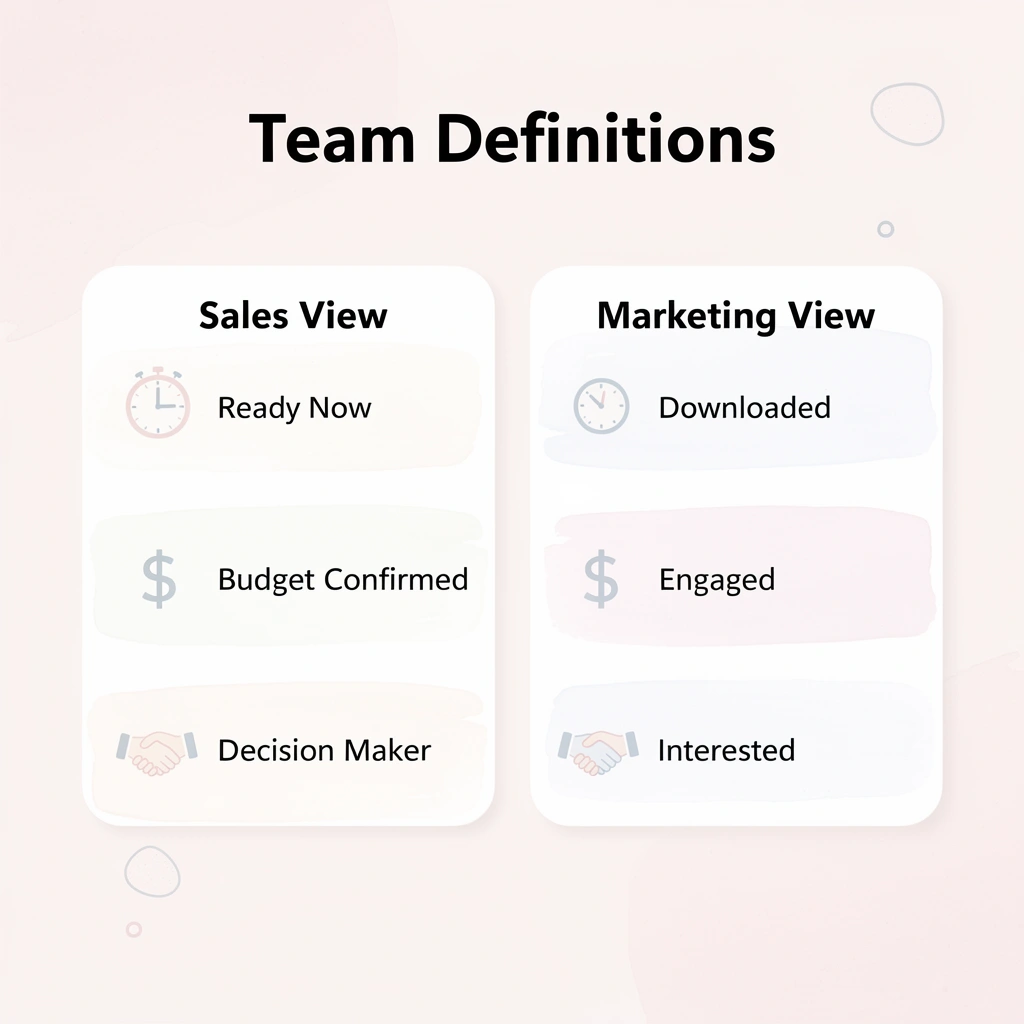
Warning: If your sales team and marketing team can't agree on what makes a qualified lead, your automation will consistently deliver the wrong prospects to your sales pipeline, no matter how sophisticated your technology stack becomes.
What's causing the low conversion rates?
According to MarketingSherpa, 79% of marketing leads never convert to sales. This isn't a lead generation problem—it's a systems problem. Most setups automate the wrong priorities: capturing contact information, sending generic email sequences, and logging activities no one reviews. Meanwhile, qualifying leads, personalizing trust-building messages, and providing context to help sales teams prioritize get skipped because they're harder to automate.
Where does the real cost of poor automation show up?
First, bloated pipelines: marketing automation generates leads, but without shared criteria for sales-readiness, the CRM fills with unqualified contacts. Sales teams scroll past hundreds of names to find the handful worth calling. Second, wasted ad spend: without feedback between marketing automation and sales closures, you keep paying to attract the same low-intent audience. Third, sales ignore leads entirely: after too many dead-end follow-ups to unqualified contacts, reps stop trusting the system. Notifications pile up, and no one acts on them.
What causes disconnected systems to fail?
The real problem isn't automation itself, but when different systems don't work together and use different success metrics. Marketing measures form fills and email opens; sales measures conversations and closed deals. A lead scores highly on the marketing automation platform based on page views and content downloads, is passed to sales, and dies because the person was researching a project six months out. No workflow optimization fixes that if the systems never agreed on timing, intent, or readiness.
Why don't more tools solve the conversion problem?
Teams often try to solve this by adding more tools: another integration, another dashboard, another layer of automation to route leads based on behavior scores that don't reflect actual buying intent. Conversion rates stay flat. What's missing isn't more automation but intelligence that understands the full context: what the lead did, what sales needs to know, and how to bridge the two without manual translation. Platforms like Bud's AI agent navigate complete business systems rather than running isolated workflows, adapting to how teams operate instead of forcing rigid handoffs between marketing and sales tools.
Research from Forrester shows that companies excelling at lead nurturing generate 50% more sales-ready leads at 33% lower cost. The difference isn't volume: it's alignment. When automation is built on shared definitions, real-time context, and systems with genuine intelligence, conversion becomes predictable.
But fixing the conversion problem requires understanding what automation should do in the first place, and that's where most definitions fall apart.
What Sales and Marketing Automation Actually Means (And What It Should Do)
Automation is a trigger that starts a process, which produces an outcome. Marketing automation and sales automation follow this same pattern toward different outcomes, yet most organizations never reconcile the gap.

Key Point: The fundamental disconnect between marketing and sales automation isn't about technology—it's about misaligned objectives and incompatible processes that create organizational friction.
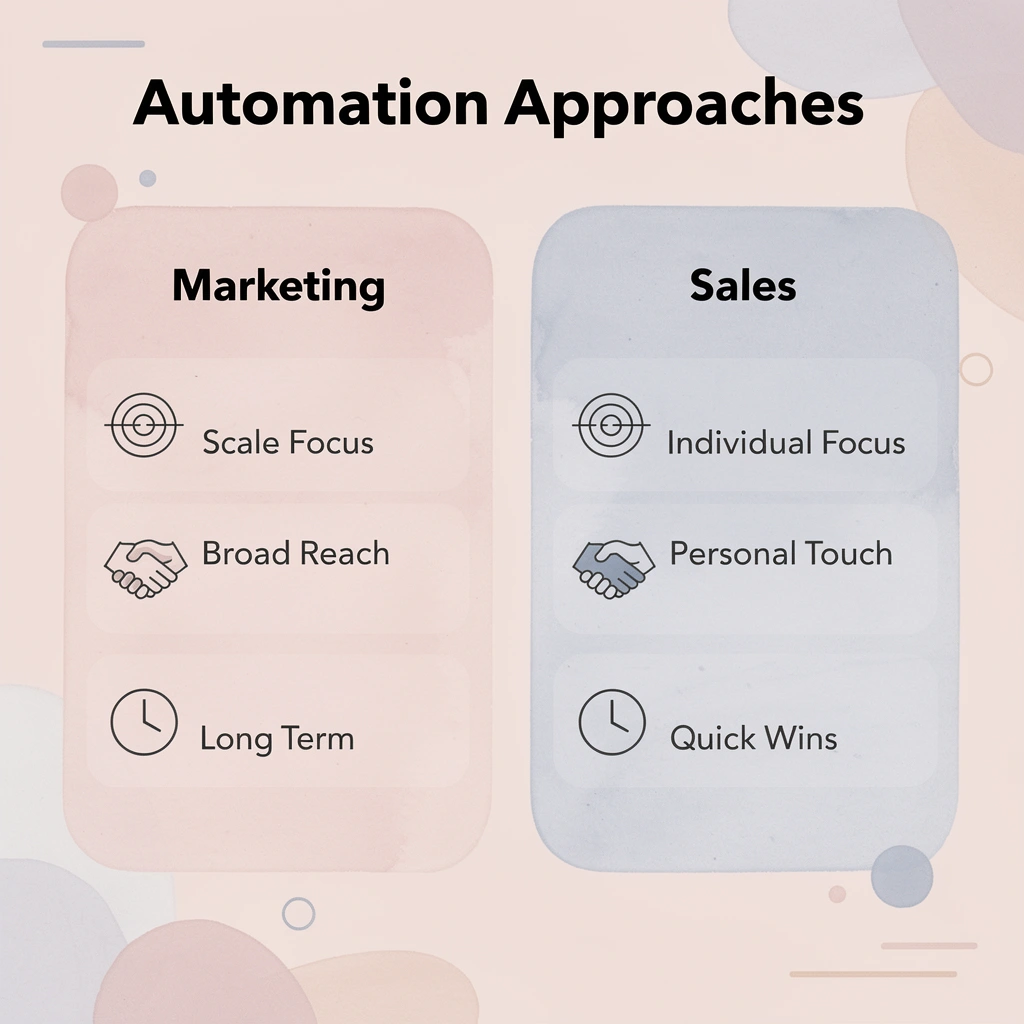
"Marketing automation focuses on nurturing leads at scale, while sales automation prioritizes individual relationship management—two fundamentally different approaches that require strategic alignment."

| Marketing Automation | Sales Automation |
|---|---|
| Lead nurturing at scale | Individual relationship management |
| Broad targeting campaigns | Personalized outreach |
| Long-term engagement | Short-term conversion |
| Brand awareness focus | Revenue generation focus |
| Warning: Without proper integration between these systems, your marketing qualified leads will consistently fail to convert through the sales funnel, creating waste and missed opportunities |
Marketing automation, lead capture, and nurturing
Marketing automation captures contact information through form submissions, guide downloads, or ad clicks, then triggers nurturing sequences: emails, content recommendations, and lead scoring based on engagement. Platforms like HubSpot, ActiveCampaign, and Marketo measure success by the number of leads generated, email open rates, click-through rates, and lead scores that signal sales readiness.
Marketing Automation Metrics
- Number of leads generated: Counts how many new potential customers marketing campaigns attract, reflecting lead generation effectiveness.
- Cost per lead: Calculates marketing spend divided by the number of leads acquired, measuring campaign efficiency and budget utilization.
- Campaign ROI: Assesses the return on investment for marketing campaigns by comparing revenue generated to campaign costs.
- Email open and click-through rates: Track engagement levels with email campaigns, indicating content relevance and audience interest.
- Lead-to-MQL conversion: Measures the percentage of leads that become Marketing Qualified Leads, showing the quality of lead nurturing.
Though focused on different metrics, both sales and marketing automation work together to drive business growth and profitability.
Marketing Automation vs Manual Marketing
| Manual Marketing | Marketing Automation |
|---|---|
| Send individual emails one by one | Set up workflows that send thousands of personalized emails |
| Post to social media in real-time | Schedule weeks of content across multiple platforms |
| Manually track lead interactions | Automatically score and prioritize leads based on behavior |
| Guess the best time to reach contacts | Use data to optimize send times for each individual |
| Spend hours on repetitive tasks | Focus on strategy while software handles execution |
According to Salesgenie, 80% of marketing automation users saw an increase in leads. Email campaign automation lets you design templates once, segment lists by behavior or demographics, and schedule sends automatically. Lead scoring adds intelligence by assigning points when prospects visit your pricing page or open multiple emails, enabling efficient lead generation.
Sales automation qualification, follow-ups, and pipeline movement
Sales automation streamlines lead qualification, outreach sequences, follow-up reminders, proposal generation, meeting scheduling, and pipeline tracking. Tools like Salesforce, Outreach, or Salesloft measure success by conversation frequency, deal velocity, and revenue booked.
Salesgenie reports that marketing automation drives a 14.5% increase in sales productivity. Sales automation enables reps to follow up more effectively, track touchpoints, and advance qualified opportunities. Proposal automation accelerates quotes, SMS follow-ups maintain prospect engagement, and pipeline dashboards identify stalling deals.
Sales Automation Metrics
- Conversion rate: The percentage of leads that become paying customers, indicating sales effectiveness and pipeline quality.
- Deal value: The average revenue per closed deal, indicating sales profitability and customer worth.
- Sales cycle length: the time from first contact to deal closure, indicating sales efficiency and process speed.
- Revenue per sales rep: the revenue generated by each sales representative, useful for evaluating individual performance and setting goals.
- Order frequency: How often customers place orders, indicating customer loyalty and repeat business.
Analytics-driven sales performance tools help teams forecast growth by analyzing metrics to predict future sales trends and inform strategic decisions.
Why does the handoff between marketing and sales create misalignment?
The failure point is the handoff. Marketing automation sends scored leads to sales based on criteria that don't align with what sales needs to close deals. Marketing optimizes for awareness and demand creation (page views, email opens, content downloads), while sales optimizes for revenue and deal velocity (budget, authority, timing, intent). When both sides automate without shared definitions, the gap widens.
A lead scores high because they downloaded three whitepapers and visited the pricing page twice. Marketing automation flags them as sales-ready, and sales automation queues a follow-up sequence. The rep calls, and the prospect says they're researching for a project launching in six months. Marketing counted engagement; sales needed buying intent. Automation made both sides more efficient at working toward conflicting goals.
How do teams try to bridge automation gaps, and why does it fail?
Teams try to fix this by connecting the CRM with the marketing platform, creating custom workflows, and setting up behavior-based routing. Conversion rates remain unchanged because the core problem persists: marketing sends leads optimized for volume, while sales rejects them based on revenue potential. Automation simply accelerates this misalignment.
Platforms like Bud's AI agent navigate complete business systems rather than running isolated workflows, adapting to how teams operate instead of forcing rigid handoffs between tools with misaligned goals.
What are the real costs when automation amplifies misalignment?
The real cost shows up in wasted effort and eroded trust. Marketing automates lead capture, generating hundreds of contacts that sales automation efficiently qualifies out. Sales stops trusting the pipeline. Marketing keeps optimizing for metrics that don't translate to revenue.
Automation amplifies the misalignment because both sides are doing exactly what their systems were designed to do. Until the trigger, process, and outcome align across the full funnel, automation accelerates dysfunction.
Understanding what went wrong is only half the solution. The harder part is knowing what to build instead.
How to Build Sales and Marketing Automation That Actually Converts
| Aspect | Sales Automation | Marketing Automation |
|---|---|---|
| Primary Goal | Close deals and generate revenue | Attract and nurture leads |
| Funnel Stage | Middle to bottom | Top to middle |
| Main Users | Sales reps and managers | Marketing teams |
| Focus Area | Execution and conversion | Awareness and engagement |
| Type of Automation | Task-based workflows | Campaign-based workflows |
| Key Data | Orders, customers, revenue | Leads, engagement, behavior |
| Success Metrics | Conversion rate, sales value | Lead volume, campaign ROI |
| Customer Role | Buyers and active prospects | Visitors and early-stage leads |
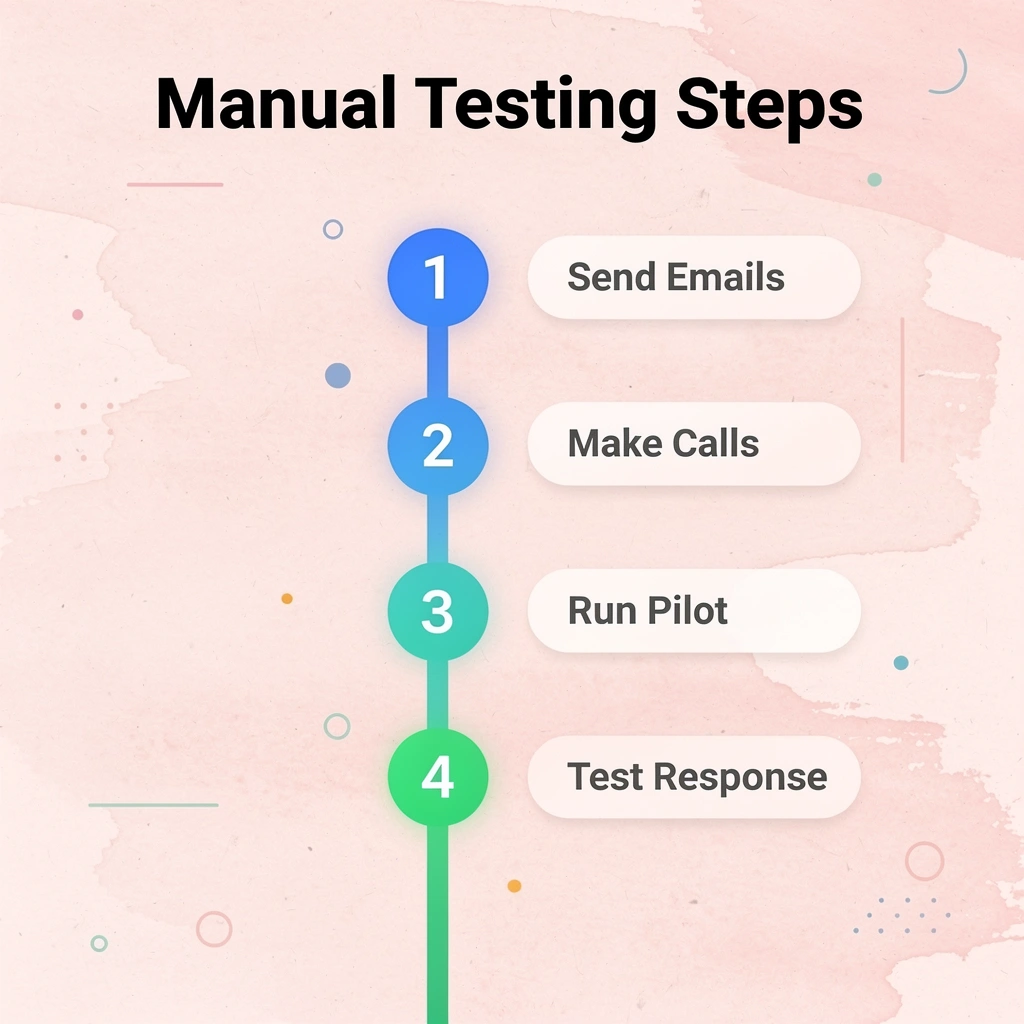
Start with the manual work. Before automating anything, verify that the problem you're solving exists and that people will respond to your solution. Send 50 personalized emails. Make 30 calls. Run a pilot campaign with hand-picked prospects. If those efforts don't convert, automation won't fix it: it will scale failure faster. Key Point: Manual validation is essential before automation. Hand-crafted outreach reveals what works and what doesn't. Warning: Automating a broken process amplifies problems rather than solving them. Test manually first.
Why do most automation efforts fail to convert?
The pattern I see most often is teams jumping straight to workflows before proving the offer works. They build lead scoring models for unqualified audiences, automate nurture sequences before knowing what messaging resonates, and integrate tools to move leads through pipelines that haven't closed a single deal manually. Automation should remove friction from a process that already works, not create the process itself.
Where should you identify automation opportunities first?
Ask your sales team which tasks make them want to throw their laptop out the window. Ask marketing which manual processes feel like swimming against the current. The answers reveal where automation creates the most value.
Repetitive data entry, lead scoring that requires spreadsheet archaeology, and follow-up sequences that depend on someone remembering to check a dashboard at 2 PM on Tuesday are conversion killers because they introduce delays and inconsistencies when prospects need speed and relevance.
What's the real bottleneck in lead generation?
According to InsiderOne, 80% of marketers say marketing automation generates more leads. The real problem isn't lead volume; it's the gap between when someone shows interest and when a human responds with something personal, not templated.
Why does integration matter more than individual features?
Buying separate tools for email sequences, CRM updates, lead scoring, and analytics creates the problem automation should solve: five dashboards, three sources of truth, and a sales team that distrusts marketing's lead quality because data never syncs. InsiderOne found that 77% of companies using marketing automation see increased conversions, but only when automation connects sales and marketing into a single system that shares context, not just contact records.
How can AI agents solve integration challenges?
When a prospect downloads a whitepaper, visits your pricing page twice, and opens three emails in 48 hours, that signal should trigger a sales alert with full context, not a generic "new lead assigned" notification. Most platforms require manual logic via Zapier chains or custom integrations, which break when APIs change.
Solutions like Bud give AI agents full computer access to navigate between tools, pull data, and execute multi-step workflows without scripting every scenario in advance. The AI agent learns patterns instead of requiring you to define them.
What criteria should marketing and sales agree on first
Marketing and sales must agree on what "sales-ready" means: budget confirmed, decision-maker identified, timeline within 90 days, pain point articulated. According to InsiderOne, 77% of companies using marketing automation see higher conversion rates when both teams optimize for the same outcome.
If marketing automates lead capture based on content downloads while sales qualify based on budget and authority, the handoff breaks.
How should automation support these shared criteria
Build automation around these shared criteria. When a lead reaches the threshold, show context that helps sales prioritize: pages visited, content consumed, questions asked, and timeline mentioned.
The automation should answer what every rep asks before picking up the phone: "Is this worth my time right now?" Otherwise, you're automating data transfer, not qualification.
What tasks should you automate versus keep manual?
Use automation for tasks that take time but add no value, such as data entry, meeting scheduling, follow-up reminders, proposal generation, and activity logging. InsiderOne reports that marketing automation can increase sales productivity by 14.5%, with most gains from eliminating grunt work rather than replacing human judgment. Reps spend less time updating CRM fields and more time on conversations that move deals forward.
Where should human interaction remain essential?
Keep the human touch where trust gets built: personalized outreach, discovery calls, objection handling, and negotiation. These require context, empathy, and adaptability that workflows cannot replicate. Prospects disengage when follow-up feels robotic.
Automation should create space for relationship-building, not replace it. Our AI agent handles system navigation—pulling data, updating records, and triggering next steps—while reps focus entirely on the conversation itself, adapting in real time instead of following a predetermined script.
Build feedback loops between systems
Automation fails when data flows in only one direction. Marketing sends leads to sales but never learns which ones were closed or why others weren't. Sales updates deal stages in the CRM, yet marketing never adjusts targeting based on what's converting.
How do you close the feedback loop effectively?
Close that loop. When a deal closes, send that signal back to marketing automation so it can find more prospects who resemble that buyer. When sales rejects a lead, document the reason so marketing stops attracting that type of person.
Why should automation learn from outcomes instead of just activities?
Most integrations sync data without creating intelligence. A lead moves from the marketing platform to the CRM, but the context of why it converted or stalled stays siloed. Build automation that learns from outcomes, not activities.
If leads from a specific campaign consistently stall at the demo stage, the system should flag that pattern and adjust targeting or messaging upstream. If prospects who engage with certain content close faster, prioritize similar profiles in the lead scoring process. Automation should grow smarter over time, not faster.
Even the best-designed system requires someone to manage, monitor, and fix it unless you build it to run itself.
Stop Managing Automation—Let It Run Itself With Bud
If your automation requires constant monitoring, manual patches, or someone switching between tools to keep workflows moving, the problem isn't the automation itself. You've built a system that requires babysitting instead of one that operates independently. Real automation shouldn't create a new job. It should eliminate the work entirely. Key Point: Most setups stitch together platforms that weren't designed to talk to each other. A form submission in one tool triggers an email in another, updates a field in the CRM, scores the lead in a third system, and hopefully routes it to sales without someone manually checking that each step is completed. When one integration breaks or a field mapping changes, the whole sequence stalls. You find out days later when a rep asks why leads stopped flowing.
"When one integration breaks or a field mapping changes, the whole sequence stalls. You find out days later when a rep asks why leads stopped flowing."
Bud's AI agent works differently. Instead of connecting tools through fragile integrations, it navigates your entire system the way a person would. It can open websites, fill forms, pull data from one platform, update records in another, and execute multi-step workflows across your stack without pre-built connectors. When a lead arrives, Bud captures the information, enriches it with context from other sources, updates your CRM, and triggers the follow-up sequence—no integrations to maintain or workflows to rebuild when a tool updates its API.
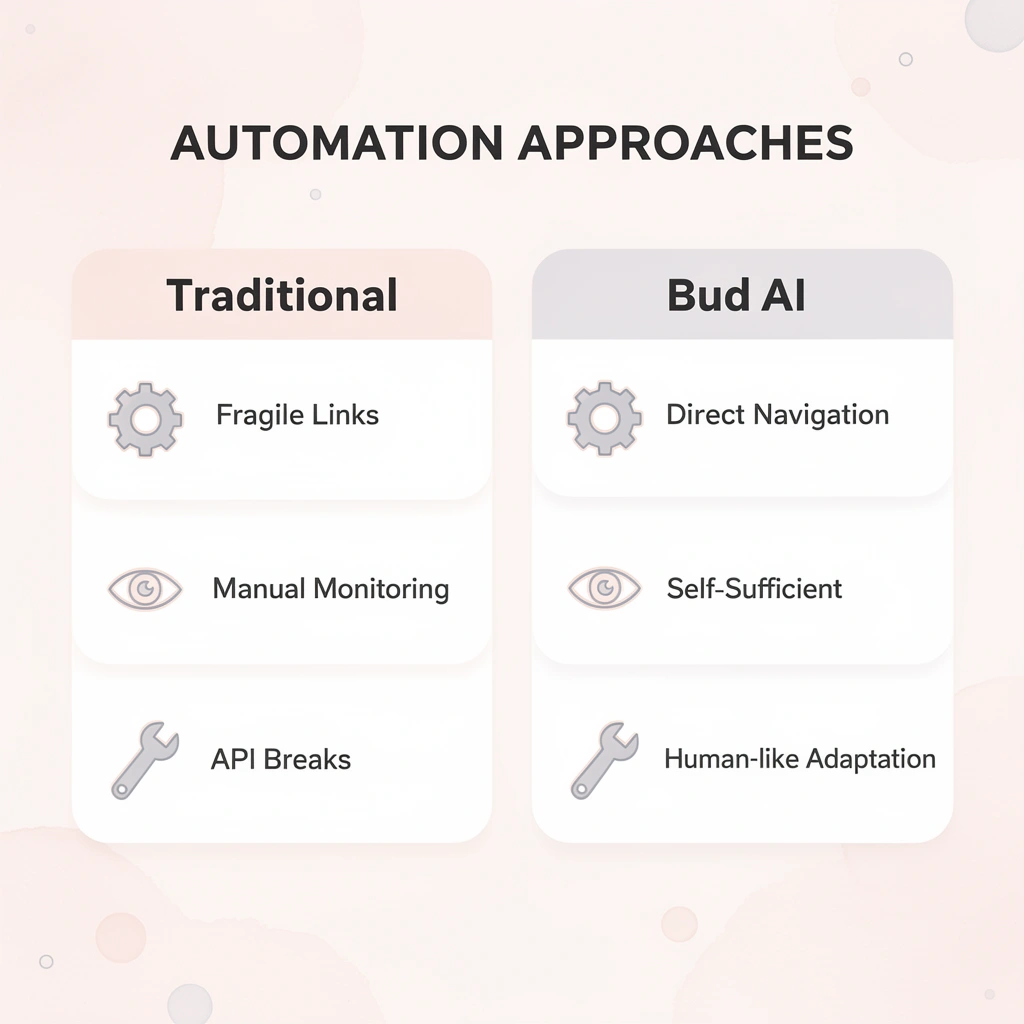
Warning: That means no more leads sitting unworked because a Zapier connection timed out. No more broken automations between your marketing platform and CRM that require a developer to troubleshoot. You can run your first workflow in under five minutes: capture a lead, enrich the data, log it in your CRM, and send a personalized follow-up.
| Traditional Automation | Bud's AI Agent |
|---|---|
| Fragile integrations | Direct system navigation |
| Manual monitoring required | Self-sufficient operation |
| Breaks when APIs change | Adapts like a human would |
| Complex troubleshooting | No integrations to maintain |

Takeaway: Automation should get smarter and more self-sufficient over time, not more complex to manage. If you're still the one keeping it running, you haven't automated the process.